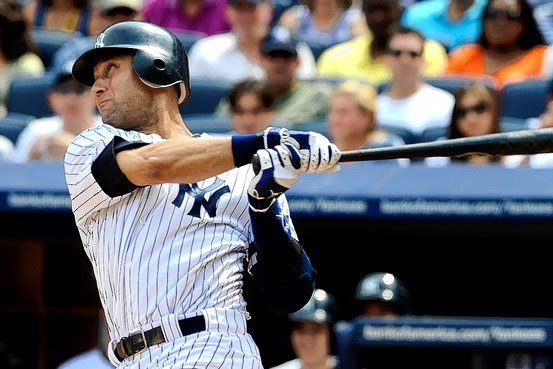
Derek Jeter has had a great career, but last year he hit .270 (mediocre)). Nonetheless, he's fielding offers like $45MM for 3 years. Yet, no one seems very angry about exhorbitant pay in athletics, as compared to CEOs. Here's Holman Jenkins over at the WSJ:
Said one fan on a New York paper's website: "As far as the money is concerned, I really don't care what they pay him. It's not my money." If it were catching, this healthy-minded attitude toward the paychecks of our fellow man would make the world a better, happier place.
Jeter clearly has alpha in a narrowly defined sphere that most of us recognize. We can see he is good at what he does--much better than us or anyone we know personally--and thus earns his pay. In contrast, the suspicion is that CEOs are merely involved in a massive crony-capitalism game that discriminates against those who don't have the right family and friends. That strikes many as unfair.
Former Clinton Attorney General Jamie Gorelick made $40MM while running Fannie Mae and the mortgage market into the ground. Rahm Emmanuel made made $16.2 million in his two-and-a-half-years as an investment banker. Bob Rubin pocketed $150MM while working for Citigroup. The list goes on and on (recent OMB director Peter Orzag was just hired as an investment banker by Citibank). These are problematic because we know they are getting paid merely for access--Rubin claims he was totally unaware Citi had $54B in mortgages on their balance sheet, which was probably true--for getting the right person to answer a phone, or bury some exception in the latest 2000-page bill or trade agreement. That's a game not available to most of us.
But then there are (relatively) unconnected CEOs who merely make too much. Merrill Lynch CEO Stanley O'Neal made $46MM and $48MM in 2006 and 2007 respectively, then got a $161MM severance package after Merrill was sold for a song to Bank America. As noted in 'The Devils are All Here', he golfed every day, and basically had no idea what was going on related to mortgage exposure that would destroy his firm. Managers of large firms are rarely the brightest and best (exceptions usually being founders), but rather someone of steady temperament.
The CEO is often a compromise between conflicting groups. He must be blithely ignorant about the inconsistent objectives articulated to the team, such as trying to simultaneously prioritize innovation and tradition, a meritocracy that aggressively promotes racial bean-counting, or a strong sexual harassment policy and a really fun Christmas party. People who are really good at logical puzzles, who excel at something, are often not very good at managing people because they can not, or will not, suffer fools well. Thus, in spite of conspicuous examples where the highest IQ person is both an idea generator and the boss such as Larry Ellison or Bill Gates, in general the functions involve different skill sets. The result is a leader in a modern reverse dominance hierarchy who is paid to keep the peace and make people feel good, as opposed to make really important strategic and tactical decisions. It's a skill, but not one worth tens, let alone hundreds, of millions of dollars.
We don't mind inequality when we know it is for true alpha. What bothers people, and I think rightly, is when people are getting paid when they really do not have alpha, in that their ability to chair meetings, spout cliches at group functions, or golf leisurely, is something anyone could do. In contrast, if we played shortstop for the Yankees we know the team would suffer. It's a problem I don't have any solution for.


